
Is world travel obsolete?
Why we can never know all we need to know just sitting in our living rooms.

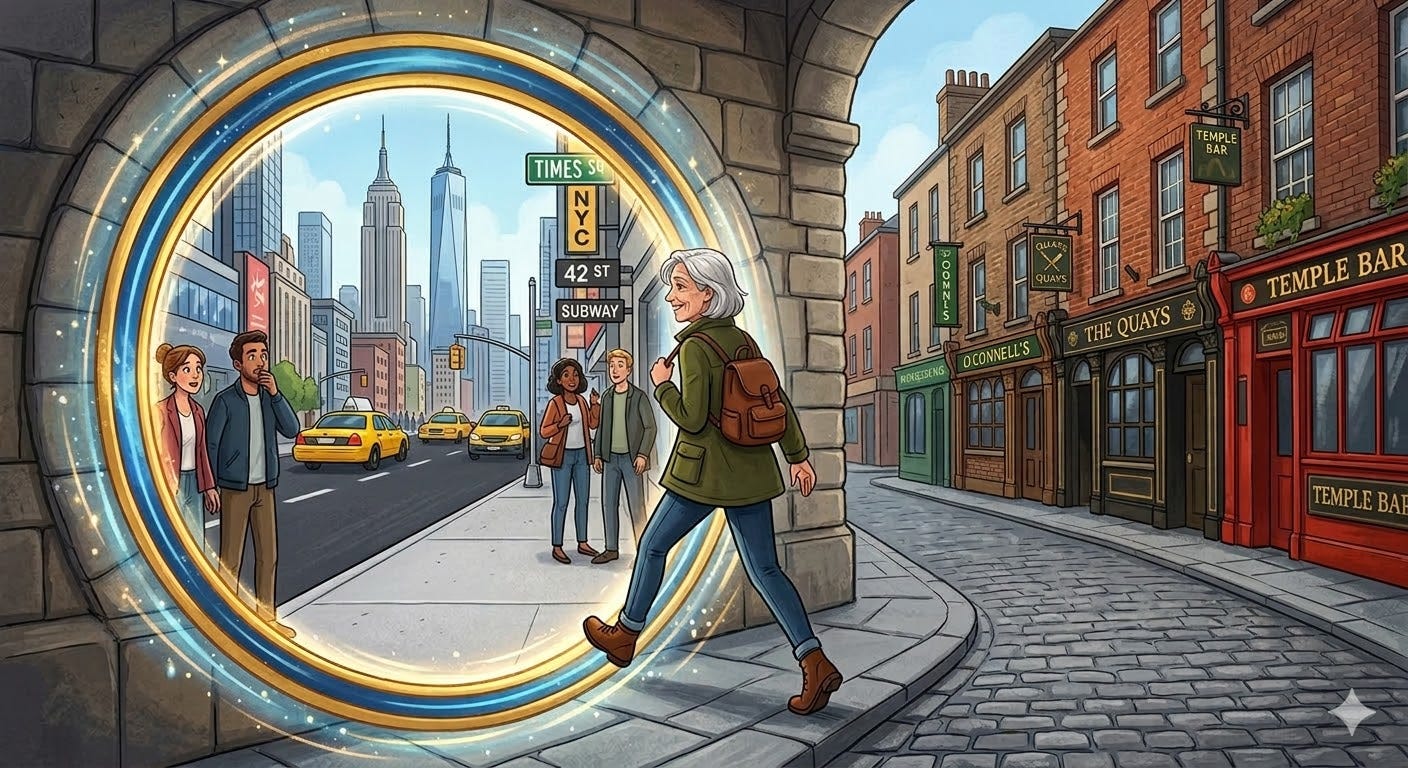
In May 2024, a window opened between Dublin and New York City. The “Portal” — a circular high-definition livestream — allowed residents of both cities to wave, dance and pull faces at one another in real time across the Atlantic.
It was a viral sensation that felt like science fiction, and it sparked a provocative question: in an era of instant global connectivity, has physical travel finally become obsolete?
Technologically, the world has never been smaller. Through advanced survey technology, satellite imagery and high-resolution street views, we can navigate the winding mews of London or the ruins of Petra from our own sofa.
The barriers to entry for foreign cultures have crumbled; we can master Mandarin on an app, attend lectures from the Sorbonne via a laptop and immerse ourselves in the history of the Andes through a VR headset.
Even our palates are catered for, wherever we are. The globalisation of logistics means you can find authentic cacio e pepe in Melbourne or street-style tacos in Birmingham.
We can “taste” the world and “see” its landmarks without ever clearing a security checkpoint or enduring a flight crammed into a middle seat.
However, there is a fundamental hollowness to the digital experience. There is a point where the simulation ends and the soul begins.
You can view a 360-degree render of the Blarney Stone, but you can’t lean back into the cool, damp air of County Cork to kiss it. You can track a climber’s GPS coordinates up the Khumbu Icefall, but your lungs will never burn with the thin, biting air of Everest.
Digital immersion provides the data of a place, but it lacks the viscerality of being there.
While the “If it’s Tuesday, this must be Belgium” style of checklist tourism may be a thing of the past, it cannot be entirely replaced by the convenience of screen surfing.
We must be careful not to mistake information for intimacy, because nothing is truly “real” until it is felt.
You can’t know a people until you walk in their shoes, breathe their air and navigate their unspoken social cues.
Real travel forces us into an uncomfortable but vital place, where genuine understanding and growth can happen.
Ultimately, experiencing foreign places remains the great hope of our world. In a fractured geopolitical landscape, it is remarkably hard to hate someone when you have shared a meal with them and appreciated that their concerns are very similar to yours.
While the “Portal” is a beautiful bridge, it remains a glass wall; to truly understand the world, we must still be willing to cross the threshold.
If you like what I’m doing here, you may want to buy me a coffee.
Grade points, if anything, the digital experiences have made us even more aware of how great feeling things in real life actually is.
Grade points, if anything, the digital experiences have made us even more aware of how great feeling things in real life actually is.